
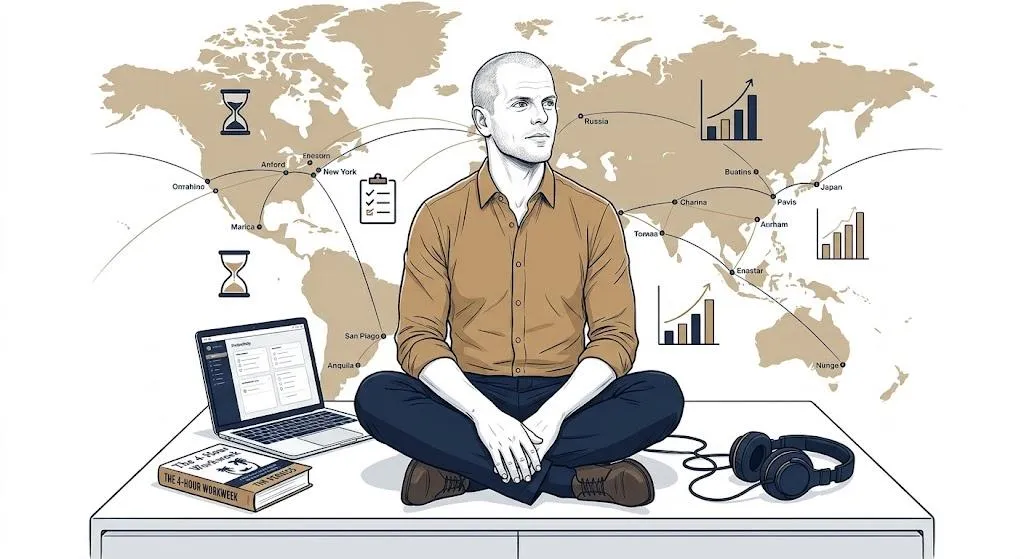
In 2007, a 29-year-old entrepreneur who had nearly had a nervous breakdown running a sports nutrition supplements company published a book that promised readers they could work four hours a week, escape the nine-to-five grind, and live anywhere in the world. Publishers rejected it 26 times. When it finally came out, The 4-Hour Workweek spent four years on the New York Times bestseller list, sold over two million copies, and fundamentally changed the conversation about work, freedom, and entrepreneurship for an entire generation. Tim Ferriss did not just write a book. He launched a philosophy, and then built a media and investment empire on top of it.
Early Life and Career Foundation
Timothy Ferriss was born in 1977 in East Hampton, New York. He studied neuroscience and East Asian studies at Princeton, where he also became a national champion in Chinese kickboxing, a detail that reveals something essential about how he approaches every domain: he looks for the precise set of inputs that produce disproportionate outputs, what he would later call the minimum effective dose.
After Princeton he took a series of sales jobs, moved to Silicon Valley, and eventually founded BrainQUICKEN, a sports nutrition supplements company that he ran from 2001. The business was profitable but consuming. He was working 14-hour days, managing customer service nightmares, and physically burning out. The crisis forced him to ask a question that most entrepreneurs never ask: what if the system itself is wrong? What if the goal is not to work harder but to design a life that requires working less?
He began outsourcing tasks to virtual assistants in India, automating his company’s operations, and testing what happened if he simply stopped showing up to manage things that did not require him. The business kept running. He booked a flight to Europe and began traveling. The experience became the book.
Business Evolution
The mindset shift at the core of Ferriss’s philosophy is the distinction between being busy and being effective. Most people optimize for activity. Ferriss optimizes for outcomes and then engineers the minimum activity required to produce them. That inversion, applied consistently across business, health, learning, and investing, is what his entire brand is built around.
His first major business move after the book’s success was not to launch another company. It was to build a media platform. He understood that the book had given him an audience of exactly the kind of people, ambitious, intellectually curious, systems-oriented entrepreneurs and professionals, who were also the most valuable audience in the world to have. Rather than monetize that audience immediately through courses and products, he invested in deepening the relationship through content.
Major Business Ventures
The 4-Hour brand became a franchise of its own. The 4-Hour Body, published in 2010, applied his experimental self-optimization philosophy to health and fitness, becoming a number one New York Times bestseller. The 4-Hour Chef, published in 2012, used cooking as a vehicle for teaching meta-learning, the skill of learning any skill faster. Each book extended the brand into a new domain while reinforcing the same core methodology.
The Tim Ferriss Show, launched in 2014, became the vehicle that transformed him from a bestselling author into one of the most influential media figures in the entrepreneurship and self-improvement space. The podcast has been downloaded over one billion times, consistently ranks among the top business podcasts globally, and features long-form conversations with world-class performers across every field. It is not a motivational show. It is a deconstruction show, focused on extracting the specific habits, routines, tools, and mental frameworks of exceptional people. That format, rigorous and specific rather than inspirational and vague, is what differentiated it from the thousands of other podcasts that launched in the same era.
His angel investing activity has been as impressive as his media career. Ferriss was an early investor in companies including Uber, Facebook, Twitter, Shopify, Duolingo, and Alibaba, among others. His combined angel investment portfolio has generated returns estimated in the hundreds of millions of dollars. His investment thesis mirrors his content philosophy: find exceptional founders early, bet on them as people rather than on their current product, and hold for the long term.
Strategic Thinking and Brand Building
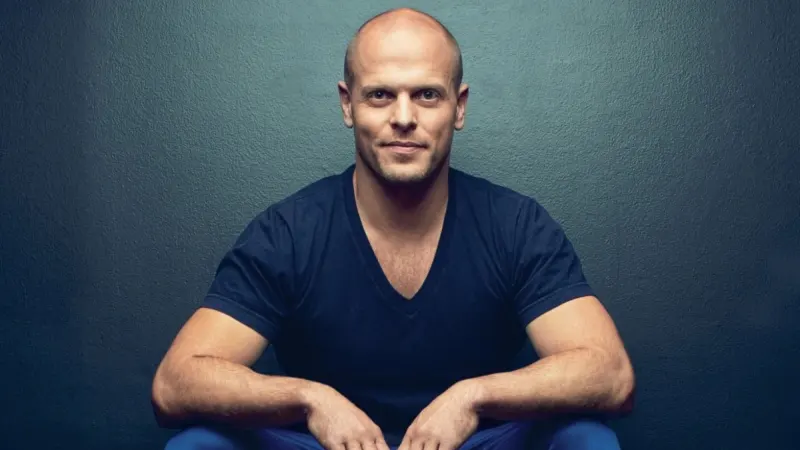
Ferriss built his personal brand around a specific and unusual promise: he is the test subject, not the guru. Everything he recommends he has personally experimented with, measured, and refined. That positioning is more credible than expertise-by-credential because it is verifiable and relatable. He is not telling you what should work in theory. He is telling you what worked on his own body, mind, and business, with the data to back it up.
His monetization model is deliberately restrained relative to his audience size. He does not run a course business, does not charge for coaching, and does not sell supplements or products. His revenue comes primarily from book sales, podcast sponsorships, speaking fees, and investment returns. This restraint is itself a brand strategy. By not aggressively monetizing his audience, he maintains a level of trust and credibility that makes everything he does recommend carry significantly more weight.
Key Lessons and Tactics
First, apply the 80/20 principle ruthlessly. Identify the 20 percent of inputs producing 80 percent of your results and eliminate or delegate everything else. Second, design the lifestyle first and build the business to support it, not the other way around. Third, test before you commit. Ferriss treats every major life and business decision as an experiment with a hypothesis, a test period, and measurable outcomes. Fourth, build an audience before you need it. His media platform creates leverage for every book launch, investment, and business venture he pursues. Fifth, the minimum effective dose is a universal principle. Whether in fitness, learning, or business, more is not always better. The right amount of the right input is what produces results. Sixth, invest in people before products. His angel investing returns came from betting on exceptional founders at the earliest stages. Seventh, protect your credibility more carefully than your revenue. Ferriss has turned down significant monetization opportunities to preserve audience trust, which is the asset that generates every other return.
Challenges, Controversies, and Failures
Ferriss has been candid about his struggles with depression and suicidal ideation, writing and speaking publicly about a period in his life when he came close to ending it. That vulnerability, rare among high-profile entrepreneurs, has paradoxically deepened his audience’s trust and humanized a brand that could easily feel aspirationally out of reach.
His early book The 4-Hour Workweek has attracted sustained criticism from people who argue that the lifestyle it promises is either unattainable for most people, dependent on privilege, or built on the labor of poorly paid outsourced workers. The outsourcing sections in particular have aged awkwardly in an era of greater sensitivity to global labor economics.
His BrainQUICKEN supplements business, which he eventually sold, was by his own account a miserable experience that nearly broke him. He has been transparent about the fact that the freedom philosophy in his book was born directly from that suffering, not from a position of ease.
Current Empire and Net Worth Perspective
As of 2025, Tim Ferriss’s net worth is estimated at approximately 100 million dollars, with a significant portion tied to his angel investment portfolio. His business ecosystem includes his podcast, his book franchise, speaking engagements, and ongoing early-stage investments through his personal vehicle. He has also become a major philanthropist in the psychedelic research space, donating millions to institutions including Johns Hopkins and Imperial College London to fund clinical research into psilocybin and MDMA-assisted therapy for depression and PTSD.
Conclusion
Tim Ferriss built his empire by asking a question that most people are afraid to ask: what if the conventional way of doing this is simply wrong? He asked it about work, about health, about learning, and about investing, and in every domain he found that the answer was worth a book, a podcast episode, or a portfolio bet.
The man who was rejected 26 times before publishing his first book went on to build one of the most trusted personal brands in the entrepreneurship world without running a single course or selling a single supplement. That restraint, in an industry defined by aggressive monetization, is perhaps his most counterintuitive and most instructive business lesson of all.