- Home
- Leadership
- Daymond John: The Man Who Stit ...

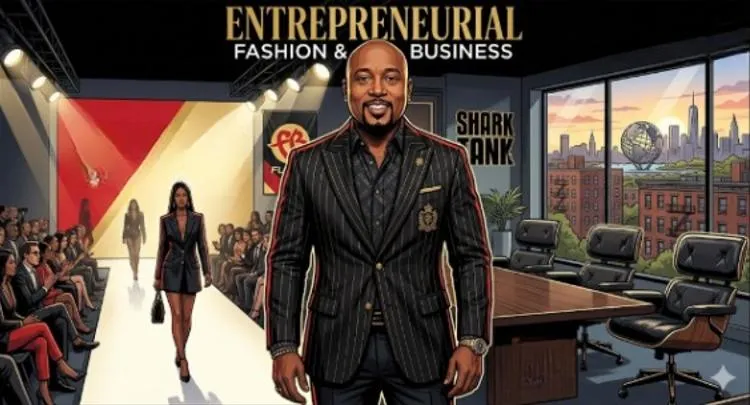
In 1992, a young man from Hollis, Queens was sewing wool hats by hand in his mother’s house and selling them on the streets of New York for eight dollars apiece. He had no fashion training, no industry connections, and no startup capital beyond a forty-dollar budget for fabric. Within a decade, that handmade hat operation had grown into FUBU, a streetwear brand that generated six billion dollars in global sales and dressed some of the most famous artists in hip-hop history. Daymond John did not enter the fashion industry. He created a new corner of it, from a sewing machine in a kitchen in Queens, by understanding something that established brands fundamentally missed: hip-hop was not a subculture. It was the future of global culture.
Early Life and Career Foundation
Daymond John was born in 1969 in Brooklyn and raised in Hollis, Queens, a neighborhood that produced Run-DMC and LL Cool J and carried a cultural identity that was loud, proud, and entirely its own. His parents divorced when he was young, and his mother Margot raised him largely alone. Rather than treating this as a disadvantage, Margot modeled entrepreneurship from the start, eventually mortgaging the family home to help her son launch his business, one of the most consequential bets a parent has ever made on a child’s vision.
Daymond showed entrepreneurial instincts early, running a commuter van service as a teenager to earn money. He worked at Red Lobster as a waiter in his late teens and early twenties, a job he has consistently cited not with embarrassment but with pride, as a lesson in customer service, hustle, and the dignity of honest work. He never treated the restaurant job as a placeholder. He treated it as a school.
The turning point came when he noticed that the wool ski hats that were popular in his neighborhood were being sold by retailers for twenty dollars but were easy to make for almost nothing. He bought fabric, taught himself to sew, and began selling hand-stitched hats on the street. The demand was immediate and the margins were extraordinary. He recognized that the gap between what things cost to make and what people in his community were willing to pay for culturally resonant products was a business opportunity hiding in plain sight.
Business Evolution
The mindset shift that transformed Daymond from a street vendor into a brand builder was his understanding that he was not selling clothing. He was selling identity. The young men and women buying his products were not just buying a hat or a jersey. They were buying membership in a cultural movement that the mainstream fashion industry had not yet recognized, let alone respected. FUBU, which stood for For Us By Us, was a declaration of ownership and authenticity that resonated with Black youth culture in a way that no established brand could manufacture or replicate.
His first major business move was one of the most creative marketing strategies in fashion history. Rather than spending money on advertising he could not afford, he got his products onto the bodies of the artists his audience was already watching. He gave clothing to LL Cool J, a childhood friend from Hollis, and the rapper began wearing FUBU in music videos and performances. When LL Cool J filmed a Gap commercial and wore a FUBU hat during the shoot, managing to include the brand’s logo in a major network advertisement without Gap’s knowledge, it became one of the most famous guerrilla marketing moments in brand history. The exposure was priceless and cost Daymond nothing.

Major Business Ventures
FUBU’s growth from a kitchen operation to a global brand was accelerated by a pivotal moment at the MAGIC apparel trade show in Las Vegas in 1993. Daymond and his partners, including childhood friends J. Alexander Martin, Keith Perrin, and Carl Brown, displayed their collection and received 300,000 dollars in orders in a single day. The problem was they had no capital to fill the orders. Daymond’s mother placed an advertisement in the New York Times offering to share the family home in exchange for a business partnership. A Korean manufacturer responded, became their production partner, and FUBU was in business at scale.
The brand was eventually picked up by Samsung America’s textile division for distribution, which took it global. At its peak in the late 1990s, FUBU was generating over 350 million dollars in annual revenue and had expanded into jeans, sportswear, footwear, and accessories. The six billion dollar figure in cumulative global sales, achieved over the brand’s peak years, established FUBU as one of the most successful independent fashion brands in American history.
Beyond FUBU, Daymond John built a significant business as an investor and brand consultant. His role on Shark Tank, which he joined at its launch in 2009, gave him a national platform that extended his brand far beyond fashion into the broader entrepreneurship conversation. Through the show he has invested in over fifty companies with a combined value exceeding one billion dollars, with particular focus on consumer products, fashion, and brands that serve underrepresented communities.
His consulting and speaking business, built on the FUBU story and the Shark Tank profile, generates significant revenue through corporate partnerships, keynote fees, and his books including Display of Power and The Power of Broke. The latter, published in 2016, articulates a philosophy that scarcity and limitation are entrepreneurial advantages rather than obstacles, a thesis drawn directly from his own experience building FUBU with no money, no connections, and no industry access.
Strategic Thinking and Brand Building
Daymond’s brand building approach centers on cultural authenticity as a competitive moat. FUBU worked because it could not be faked. It came from the community it served, was worn by the artists that community revered, and carried a name that explicitly stated its cultural ownership. No amount of market research or brand strategy could have manufactured that authenticity for an outside company.
His monetization model evolved from product margins to equity and platform. The Shark Tank platform converted his cultural credibility into investor credibility, opening doors to deal flow across categories well beyond fashion. His personal brand now generates revenue through investments, speaking, publishing, consulting, and media appearances, a diversified income architecture that is far more resilient than any single product business.
Key Lessons and Tactics
First, serve an underserved community and own that relationship before anyone else notices the opportunity. FUBU succeeded because mainstream fashion ignored hip-hop culture until FUBU had already won it. Second, guerrilla marketing beats paid advertising when you understand your audience better than your competitors do. Getting LL Cool J to wear FUBU in a Gap commercial was worth more than any billboard campaign. Third, scarcity forces creativity. The lack of capital that seemed like FUBU’s biggest obstacle produced some of its most innovative solutions. Fourth, your network is manufacturing capital. The partnership with Daymond’s mother and the Korean manufacturer replaced the bank loan he could never have gotten. Fifth, cultural authenticity cannot be purchased or manufactured. Build from the inside of a community outward, not from the outside in. Sixth, a platform multiplies your deal flow. Shark Tank transformed Daymond from a fashion entrepreneur into a cross-category investor with national visibility. Seventh, teach what you know as early as possible. His books and speaking career built an audience that reinforced and extended every other part of his business.
Challenges, Controversies, and Failures
FUBU’s decline from its late 1990s peak was sharp and instructive. The brand over-extended into categories where it lacked credibility, lost its connection to the evolving hip-hop aesthetic as the culture shifted, and was caught in the broader collapse of the urban streetwear market in the early 2000s as competitors flooded in and consumer tastes fragmented. Daymond has acknowledged that the team made classic scaling mistakes, growing distribution faster than they could manage quality and brand consistency.
He was also diagnosed with thyroid cancer in 2017, a health crisis he handled publicly and with characteristic directness. He has spoken about how the diagnosis recalibrated his priorities and deepened his commitment to mentorship and entrepreneurship education, particularly for young people from communities like the one he grew up in.
His Shark Tank investments, like those of any investor operating across dozens of early-stage companies, have included failures alongside successes. The public nature of the show means those failures are more visible than they would be in a traditional venture portfolio.
Current Empire and Net Worth Perspective
As of 2025, Daymond John’s net worth is estimated at approximately 350 million dollars. His business ecosystem includes the FUBU brand, which has experienced a cultural resurgence driven by nostalgia for 1990s streetwear, his Shark Tank investment portfolio, his consulting and speaking business, his publishing ventures, and his work through the Daymond John Success Formula, an entrepreneurship education platform focused on underserved communities. He remains one of the most active and visible advocates for minority entrepreneurship in the United States.
Conclusion
Daymond John built a billion-dollar brand with forty dollars, a sewing machine, and an understanding of his community that no outsider could have replicated. His career demonstrates that the most durable competitive advantage in consumer business is not capital or distribution or technology. It is authentic cultural resonance, the sense among your customers that your brand belongs to them as much as it belongs to you.
The young man who stitched hats in his mother’s kitchen in Queens did not just build a fashion company. He built a movement, put his community’s name on it, and showed the world that For Us By Us was not just a slogan. It was a business model.