
- Home
- Music Releases
- Gene Simmons: The Rock Star Wh ...

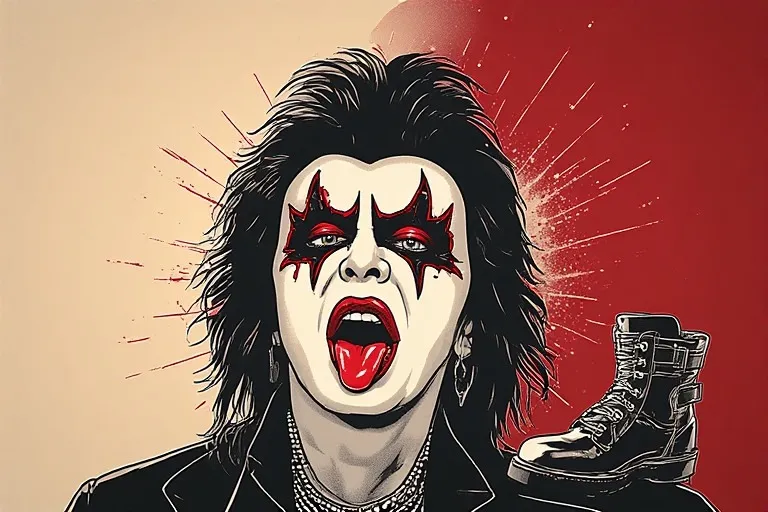
Chaim Witz was born on August 25th 1949 in Tirat Carmel, a small town near Haifa in what was then British Mandatory Palestine and became the State of Israel the following year. His mother Florence Klein was a Hungarian Jewish survivor of the Nazi concentration camps, a biographical fact whose weight is impossible to overstate in understanding the psychological formation of the man who would eventually paint his face like a demon, breathe fire on stage, and build one of the most aggressively monetised rock and roll brands in the history of popular music. Florence had survived the unsurvivable. Her son grew up with a bone-deep understanding that nothing was guaranteed, that comfort was temporary, and that the only reliable protection against the world’s indifference was the wealth and independence that came from owning things rather than simply experiencing them. Gene Simmons’s estimated net worth today sits at approximately 400 million dollars, and the architecture behind that number is one of the most deliberately constructed and unashamedly commercial wealth building operations in entertainment history. He did not stumble into his . He engineered it with a methodical intensity that his bandmates, his critics, and the broader rock music establishment found alternately impressive and deeply unseemly. The unseemly part never bothered him in the slightest.
THE KISS FOUNDING AND THE BRAND PHILOSOPHY
Kiss was formed in New York City in January 1973 when Simmons and Paul Stanley recruited Peter Criss and Ace Frehley to join a band whose concept was as important as its music from the very beginning. The face paint, the costumes, the fire breathing, the blood spitting, the elaborate stage production with pyrotechnics, hydraulic platforms, and lighting rigs that dwarfed anything contemporary rock bands were attempting, these were not decorative additions to a pre-existing musical vision. They were the vision, or at least an inseparable component of it, conceived with a clarity about their commercial function that most rock musicians of the era would have considered artistically compromised.
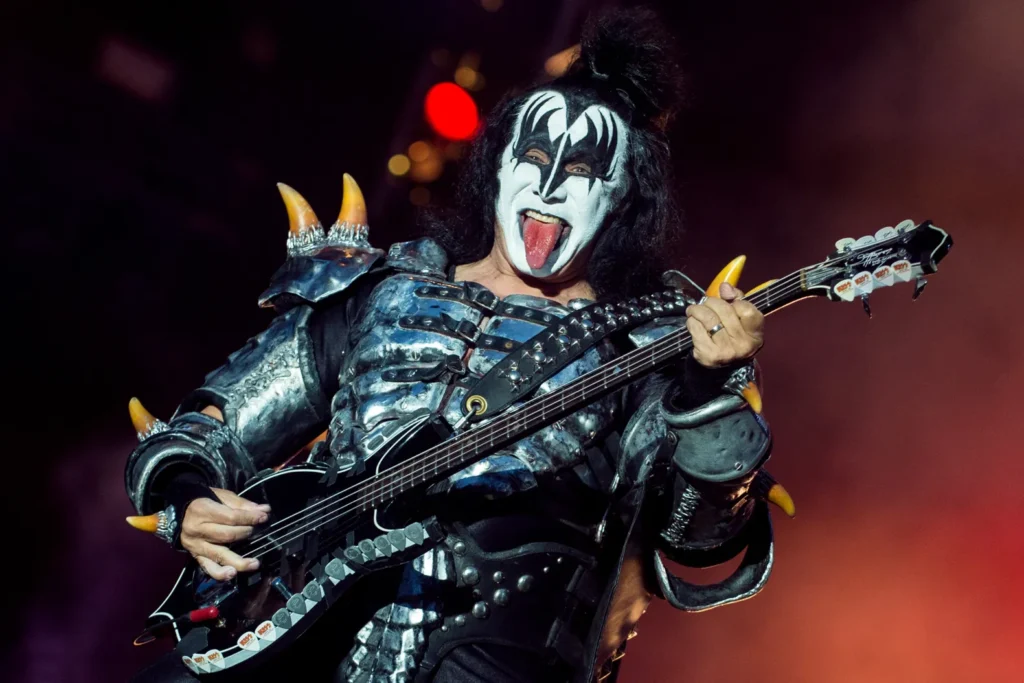
Simmons understood something that the rock establishment of the early 1970s had not fully processed: a band is a brand, and a brand that can be immediately visualised, instantly recognised, and clearly differentiated from its competitors has a commercial advantage that musical quality alone cannot produce. The four Kiss characters, The Demon, The Starchild, The Spaceman, and The Catman, were not simply stage personas. They were intellectual property assets whose value could be extended across merchandise categories in ways that a conventional rock band’s identity could not. A face is hard to put on a lunchbox. A demon character with a specific visual identity that millions of children recognise and desire to possess is considerably easier.
The decision to merchandise aggressively from the earliest years of the band’s commercial viability was made against the advice of virtually everyone in their professional circle and against the prevailing cultural norms of rock music, which regarded commercial merchandise as a compromise of artistic integrity. Simmons rejected that framework entirely and publicly. He did not consider merchandise a compromise. He considered it an income stream, and he pursued it with the same intensity he brought to every other aspect of the band’s commercial operation.
THE MERCHANDISE EMPIRE AND ITS SCOPE
Kiss merchandise reached a scope and scale that had no precedent in rock music and that has been genuinely difficult for subsequent bands to replicate even with the advantage of studying the Kiss model. The band’s licensing operation has produced over five thousand distinct products across its history, including coffins, condoms, credit cards, comic books, a branded soft drink, a branded restaurant chain, action figures, Halloween costumes, pinball machines, and virtually every consumer product category imaginable. The breadth of that licensing operation is not accidental or even primarily a function of commercial aggression. It reflects a coherent brand philosophy about the relationship between a strong visual identity and consumer product licensing.
A brand with a strong visual identity, one that can be applied to a product and immediately recognised without supporting context, has licensing value across consumer categories that weak visual identities cannot access. The Kiss logo and the four character face paint designs are among the most immediately recognisable visual identities in entertainment history, which means a manufacturer who licenses them knows that the visual association with Kiss will be understood by consumers without explanation or context. That clarity of recognition has a licensing fee premium attached to it that compounds across thousands of individual product deals over decades of commercial activity.
Simmons has estimated that the Kiss merchandise operation has generated over a billion dollars in revenue across the band’s history, a figure that dwarfs the recording royalties their music catalogue has produced and that reflects the fundamental insight behind his entire commercial philosophy: the music is the marketing, and the merchandise is the business.
THE CASABLANCA RECORDS RELATIONSHIP AND ITS LESSONS
Kiss signed with Casablanca Records in 1973, a relationship with label founder Neil Bogart that was significant for both its commercial productivity and its eventual financial complications. Casablanca’s promotional approach, which involved saturating markets with Kiss product through an aggressive touring and release schedule, built the band’s commercial infrastructure with a speed that more conservative label strategies would not have achieved. Alive, released in 1975, was the commercial breakthrough that transformed Kiss from a cult phenomenon into a mainstream commercial force, and its success was partly a product of Casablanca’s willingness to invest in a live album at a moment when the band’s studio recordings had not yet fully captured the energy of their live performance.
But the financial relationship with Casablanca was not without complications. The label’s accounting practices and the advance and recoupment structures that governed the relationship created the familiar music industry dynamic where commercial success did not always translate into commensurate artist income in real time. Simmons’s response to those complications was not simply legal action or public complaint. It was the intensification of his focus on revenue streams that the label relationship did not control, particularly merchandise and live performance, where the commercial relationship was more direct and the percentage of gross income captured by intermediaries was lower.
THE SOLO ALBUMS STRATEGY
In 1978, all four Kiss members released solo albums simultaneously, a commercially unprecedented move that Simmons has acknowledged was motivated partly by individual artistic ambition and partly by a calculated strategy to expand the brand’s market penetration. Four Kiss albums releasing simultaneously meant four times the retail presence, four times the promotional activity, and four times the opportunity to capture consumer spending from an audience whose loyalty to the Kiss brand extended across individual member identities.
The solo albums strategy was not uniformly successful commercially. Ace Frehley’s solo record performed significantly better than the others, a result that had implications for the internal dynamics of the band and for subsequent decisions about lineup and creative direction. But the strategy itself, treating the band as a brand system with multiple simultaneous product offerings rather than a single creative entity with one output at a time, reflected a sophistication about brand portfolio management that the music industry had not previously encountered at that scale.
THE UNMASKING AND THE BRAND RESET
Kiss’s decision to appear publicly without their face paint on an MTV special in 1983 was simultaneously a creative liberation and a brand risk management decision. The face paint had become so central to the Kiss identity that it also functioned as a constraint, preventing the band from pursuing commercial opportunities in contexts where theatrical costuming was impractical. Unmasking created a more versatile commercial identity that could engage with mainstream media formats, film and television opportunities, and promotional contexts that the painted identity made awkward.
The unmasked era produced commercially successful records including Lick It Up in 1983 and Animalize in 1984, demonstrating that the band’s commercial viability was not entirely dependent on the theatrical elements that had built its initial audience. But Simmons managed the unmasking as a brand event rather than simply a creative decision, ensuring that the revelation of the faces behind the paint generated media coverage and audience engagement that converted a potentially destabilising change into a promotional opportunity.
The return of the original lineup with face paint for the 1996 reunion tour, which grossed over 143 million dollars and demonstrated that the audience’s appetite for the original Kiss theatrical experience had not diminished during the unmasked years, reflected the same brand management intelligence in reverse. The face paint was a commercial asset whose value could be temporarily suspended and then restored when commercial conditions favoured its return.
THE KISS KRUISE AND THE DIRECT AUDIENCE RELATIONSHIP
The Kiss Kruise, an annual fan cruise event launched in 2011 that brings Kiss and a curated selection of supporting acts onto a cruise ship for a multi-day event exclusively for fans willing to pay significant premium prices for proximity to the band, represents one of the most sophisticated fan monetisation strategies in the history of rock music. The cruise creates a scarcity event, limited by physical ship capacity, that allows premium pricing reflecting genuine demand rather than simply ticket market pricing. It generates direct revenue from a self-selected audience of the band’s most financially committed fans. And it creates an intimate experience whose premium over conventional concert attendance reflects both the scarcity of access and the emotional significance of multi-day proximity to artists whose music has been central to participants’ lives.
The Kruise model has been widely imitated by other legacy rock acts who recognised its economic logic, but Kiss’s early adoption of the format allowed them to establish the definitive version of the experience with their audience before competitors diluted the concept. First mover advantage in fan experience innovation, like first mover advantage in most commercial categories, generates returns that later entrants cannot fully replicate regardless of their production quality.

ROCK AND ROLL ALL NIGHT AND THE CATALOGUE VALUE
Kiss’s recording catalogue, while financially secondary to their merchandise and live performance income, generates ongoing royalty income from streaming platforms, radio play, licensing, and synchronisation fees that compounds quietly across decades. Rock and Roll All Nite, Detroit Rock City, I Was Made for Lovin’ You, and Shout It Out Loud are among the most recognisable rock anthems of the 1970s and remain embedded in the cultural landscape in ways that generate licensing opportunities, advertising synchronisation fees, and the kind of organic playlist inclusion that streaming algorithms reward.
The catalogue’s value increased significantly following the band’s retirement announcement and the subsequent End of the Road Tour, which ran from 2019 to 2023 and grossed over 100 million dollars, as the cultural conversation around the band’s legacy drove renewed attention to their recorded output. Legacy catalogues consistently experience streaming growth during periods of cultural retrospective attention, and the End of the Road Tour generated exactly the kind of sustained retrospective engagement that produces those streaming gains.
THE END OF THE ROAD AND THE AVATAR DECISION
The End of the Road Tour’s conclusion in December 2023 in New York City was not the end of the Kiss commercial enterprise. Simmons and Stanley announced plans to continue Kiss as a live performance entity through the use of digital avatar technology, licensing the band’s visual identity and character intellectual property to a virtual performance operation that could continue generating live event revenue without the physical limitations that age had imposed on the original performers.
The avatar decision reflects the purest possible expression of Simmons’s brand philosophy. If the core commercial asset is the Kiss visual identity rather than the specific human beings who originally inhabited it, then the commercial case for extending that identity into new performance formats using available technology is straightforward. The characters are intellectual property. Intellectual property can be licensed, extended, and deployed in new contexts without the physical constraints that biological performers face. The decision generated cultural controversy among fans who valued the human performance dimension of the Kiss experience, but from a purely commercial perspective it reflected a logical extension of a brand management philosophy that had been consistent for five decades.
THE PERSONAL BRAND EXTENSIONS
Beyond Kiss, Simmons built personal brand extensions that reflected his commercial philosophy applied to individual rather than collective identity. His reality television show Gene Simmons Family Jewels, which ran for seven seasons on A&E beginning in 2006, generated direct income through production fees and advertising revenue while maintaining his public profile during periods between Kiss touring cycles. The show’s focus on his family life with Shannon Tweed, whom he eventually married after decades of a publicly non-traditional relationship, generated the kind of intimate access content that reality television audiences valued and that kept his personal brand commercially active independent of the Kiss enterprise.
His motivational speaking engagements, built around the same unapologetic commercial philosophy that had defined his entire career, generated premium speaking fees from corporate audiences who found his directness about money, ownership, and commercial ambition more useful than the conventional celebrity speaker’s narrative of artistic passion rewarded by . He charges what the market will bear, tells audiences exactly why he does so, and generates speaking income that reflects the genuine demand for his particular combination of commercial candour and entertainment credibility.
WHAT 400 MILLION DOLLARS ACTUALLY REFLECTS
Gene Simmons’s estimated 400 million dollar net worth is the product of five decades of decisions made by someone who never pretended that rock and roll was anything other than a business and who built the most aggressively monetised brand in the history of the genre without apology or apparent ambivalence. The merchandise operation demonstrated that a strong visual identity could generate licensing income across thousands of product categories simultaneously. The touring operation built a live performance machine whose theatrical production values justified premium pricing across multiple decades. The Kruise created a fan monetisation model that converted the most committed segment of his audience into a premium revenue stream. And the avatar decision extended the commercial life of the Kiss intellectual property beyond the physical limitations of its original human embodiment.
The lesson his career teaches is simultaneously obvious and consistently ignored by artists who prioritise artistic credibility over commercial construction. He decided early that the Kiss brand was his most valuable asset and spent five decades managing it with the discipline and commercial aggression that genuine asset management requires. Every decision, from the merchandise licensing to the reunion tour to the End of the Road to the digital avatar, reflected a consistent philosophy about the relationship between brand identity and commercial value that most rock musicians never developed and that generated returns most of them never approached. He built 400 million dollars by being exactly as commercial as he always said he was, which turns out to be the most honest thing about him.



