
- Home
- Pop Culture
- Travis Scott: How He Built the ...

Jacques Berman Webster II grew up in Missouri City, a suburb of Houston, Texas, in a household that was stable by the standards of many hip-hop origin stories. His grandmother raised him for a period, his father was an entrepreneur, and his mother worked for Apple. That last detail is more relevant than it might initially appear. Growing up in a household where a parent worked at one of the most brand-conscious, design-obsessed companies in the world gave Travis Scott an early education in the relationship between aesthetics, identity, and commercial value that most of his peers never received. He absorbed, perhaps unconsciously, the idea that a product is not just a thing you sell. It is an experience you architect. That philosophy became the operating system of everything he built.
The Escape from the Traditional Path
Travis Scott enrolled at the University of Texas at San Antonio but dropped out after one year, a decision his parents did not support and that created genuine family tension. He moved to New York with almost nothing, slept on friends’ couches, and began building connections in the music industry with the specific intention of becoming a producer first. He eventually relocated to Los Angeles and found his way into Kanye West’s circle, working at GOOD Music and absorbing everything he could about how Kanye approached the relationship between music, fashion, visual art, and cultural identity.
That apprenticeship was his real education. Kanye West is one of the few figures in entertainment history who genuinely understands that a musician’s brand is a total sensory environment, not just a collection of songs. Travis Scott internalized that lesson completely and built his entire career around its application. Every album, every tour, every sneaker drop, every fast food collaboration has been designed as a piece of a larger immersive world rather than a standalone commercial transaction.
He released his first major project Owl Pharaoh in 2013 after signing with Epic Records, but the deal structure that defined his early career was a co-signing arrangement with T.I.’s Grand Hustle label. The financial terms of that arrangement were not particularly favorable, as early co-signing deals rarely are, but the access and credibility it provided were worth considerably more than the money at that stage. He was buying market position with contractual flexibility, a trade that paid off when his commercial profile rose high enough to renegotiate from strength.
Rodeo, Birds in the Trap, and Building the Mythology
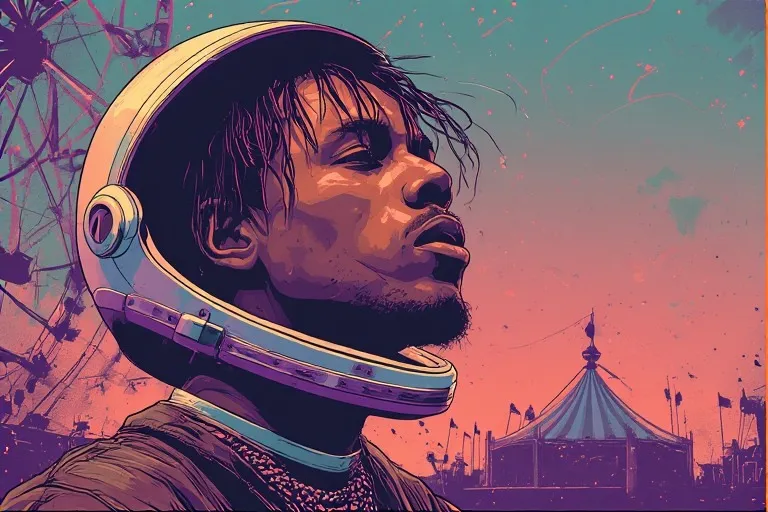
His debut studio album Rodeo in 2015 established the sonic and aesthetic identity that would define his commercial peak. The album was critically acclaimed and commercially successful, but more importantly it introduced the world to the Astroworld mythology, a dream-like, psychedelic Houston-inspired universe that Travis Scott would spend the next decade building into a genuinely valuable intellectual property ecosystem. The name referenced the beloved Houston amusement park that had been demolished in 2005, tapping directly into the nostalgia and cultural identity of his hometown audience while simultaneously creating something new.
Birds in the Trap Sing McKnight in 2016 debuted at number one on the Billboard 200 and demonstrated that his audience was growing at a rate that demanded attention from brands, labels, and partners across multiple industries. The features on that album, including Kid Cudi, André 3000, and Kendrick Lamar, were not random. They were carefully selected cultural co-signs from artists whose credibility in specific audience segments complemented and expanded his own. Feature selection at this level is a brand strategy exercise as much as it is a creative one.
Astroworld and the Album as Brand Architecture
Astroworld released in August 2018 and became the commercial and cultural peak of his recording career. It debuted at number one, generated the massive hit Sicko Mode which spent the most weeks at number one of any rap song in 2018, and transformed Travis Scott from a successful rapper into a genuine cultural phenomenon. The album was named after the demolished Houston amusement park, and the entire project was constructed as an immersive theme park experience translated into audio form.
The genius of the Astroworld concept was that it was not just an album title. It was a brand universe with essentially unlimited extension potential. A theme park name implies rides, merchandise, experiences, food, apparel, and entertainment. Travis Scott spent the years following the album’s release systematically building out every one of those categories. The Astroworld Festival, launched in 2018 in Houston, was the live experience arm of that universe. The merchandise drops associated with each project were the apparel arm. The sneaker collaborations were the footwear arm. The fast food partnership was the food and beverage arm. Each extension fed the others, and all of them fed back into the core mythology.
Nike, Jordan Brand, and the Sneaker Economy
Travis Scott’s partnership with Nike and specifically with Jordan Brand became one of the most commercially significant artist-brand relationships in sneaker history. His Air Jordan 1 collaboration released in 2019 and featured a distinctive backwards Swoosh logo, a detail so specific and so deliberate that it immediately became the defining visual signature of the collection. Pairs that retailed for around 150 dollars were reselling on the secondary market for over a thousand dollars within hours of release.
The economics of high-demand sneaker collaborations operate differently from standard endorsement arrangements. The resale market premium is not money that flows directly to the artist, but it is an enormously powerful signal of brand value that influences the terms of subsequent deals. When a retailer and a brand can demonstrate that your name on a product multiplies its market value by a factor of seven or eight, your negotiating position for the next collaboration is fundamentally transformed. Travis Scott used each successful Jordan release to justify progressively more favorable terms and progressively more creative control in subsequent collaborations.
He eventually expanded the Jordan relationship to include Air Force 1 and Air Max collaborations, each generating similar resale premiums and similar levels of cultural conversation. The cumulative value of the Jordan Brand partnership, including direct compensation, royalty structures, and the brand equity built through association with one of the most powerful footwear names in the world, is estimated to have generated tens of millions of dollars and continues to compound with each new release.
McDonald’s and the Meal Deal Model
In September 2020, Travis Scott became the first celebrity since Michael Jordan in 1992 to have a meal named after them on the McDonald’s menu. The Travis Scott Meal, a Quarter Pounder with cheese, bacon and lettuce, medium fries with BBQ sauce, and a Sprite, was straightforward in its components but extraordinary in its commercial execution. McDonald’s locations across America reported running out of Quarter Pounder ingredients within days of the promotion launching. The partnership generated an estimated 15 million dollars or more in direct compensation and merchandise sales combined.
But the McDonald’s deal was significant beyond its immediate financial return. It demonstrated something about Travis Scott’s brand that no amount of music sales data could prove as concisely: his audience would physically change their behavior based on his association with a product. They drove to McDonald’s specifically because of him. That behavioral influence, the ability to generate real-world consumer action rather than just social media engagement, is the metric that the largest consumer brands in the world use to determine partnership value. By proving that metric at McDonald’s scale, Travis Scott positioned himself for partnership conversations with brands operating at the very top of global consumer culture.
The McDonald’s relationship also produced merchandise collaborations that sold out immediately, including Cactus Jack branded packaging and apparel that blurred the line between fast food promotion and streetwear drop. That creative approach to a fast food partnership, treating it as a fashion and cultural moment rather than a simple endorsement, elevated the commercial ceiling of what celebrity meal deals could achieve and set a template that other artists subsequently attempted to replicate.
Cacti and the Beverage Play
In 2021, Travis Scott launched Cacti, an agave-based hard seltzer developed in partnership with Anheuser-Busch. The product entered the hard seltzer market at its commercial peak, positioning itself as a premium lifestyle option within a category that was growing rapidly but struggling with brand differentiation. Cacti’s packaging, visual identity, and marketing were designed with the same aesthetic precision as his music projects, making it feel like a genuine brand extension rather than a celebrity licensing exercise.
The product was discontinued in 2022 in the aftermath of the Astroworld Festival tragedy, as Anheuser-Busch determined that the association had become commercially problematic. The discontinuation represented a real financial and strategic setback, but the original concept and its early market reception demonstrated his ability to build consumer products with genuine brand identity in competitive categories.
The Astroworld Tragedy and the Business Consequences
On November 5, 2021, ten people died and hundreds were injured in a crowd crush at the Astroworld Festival in Houston. The tragedy was one of the most devastating events in modern concert history and generated thousands of lawsuits, extensive media scrutiny, and profound questions about event safety, artist responsibility, and the culture of high-intensity concert environments. The human cost was immeasurable and irreducible to any business analysis.
The commercial consequences were severe and immediate. Brand partners paused or terminated relationships. Nike delayed sneaker releases. Cacti was discontinued. The Astroworld Festival was cancelled permanently. His public profile entered a prolonged period of reputational difficulty that required careful and sustained navigation. The legal exposure from the lawsuits represented potential financial liability on a scale that threatened the business infrastructure he had built over a decade.
His response was to largely withdraw from public activity, settle legal matters progressively, and allow time and new work to gradually rebuild his commercial standing. The Utopia album released in 2023 debuted at number one and demonstrated that his core audience remained intact despite everything. The commercial recovery was not complete but it was real, and it provided the foundation for a cautious resumption of brand partnership activity.
Cactus Jack and the Ownership Structure
Throughout his career Travis Scott has operated his business interests through Cactus Jack Records and the broader Cactus Jack brand infrastructure. The label has signed artists including Don Toliver and Sheck Wes, functioning as both a genuine talent development operation and a brand extension vehicle. Operating as a label owner rather than purely as a recording artist means participating in the upstream economics of music, earning from the success of signed artists rather than being solely dependent on personal recording output.
His production company has been involved in film and television development, and his creative direction work for major brands has been structured as genuine consulting and design engagement rather than passive endorsement. The Cactus Jack aesthetic, a specific visual language drawing on psychedelia, Americana, and Houston culture, has become recognizable enough to function as a brand in its own right, independent of any specific product or project it is applied to.
The Financial Architecture
Travis Scott’s estimated net worth sits at approximately 80 million dollars as of 2025, assembled from music royalties, touring income before the Astroworld tragedy, Jordan Brand partnership returns, the McDonald’s deal, merchandise operations through Cactus Jack, label income from signed artists, and brand consulting arrangements. The number would almost certainly be higher had the events of November 2021 not disrupted several significant commercial relationships simultaneously.
What his career demonstrates, even accounting for its most difficult chapter, is the commercial power of total brand immersion. He did not build a music career and attach a business to it. He built an experiential universe and music was one of the entry points into it. The sneakers, the fast food, the festival, the merchandise, the visual aesthetic, all of it was the same product delivered through different commercial channels. That integration is what the most valuable entertainment brands in the world are built from, and Travis Scott understood it earlier and applied it more consistently than almost anyone in his generation. Houston shaped the mythology. The mythology built the empire.



