


She ran 100 meters in 10.72 seconds. She also ran one of the most effective personal brand rebuilding campaigns in modern sports history and she did it in roughly the same amount of time.
When Sha’Carri Richardson was suspended from the 2021 Tokyo Olympics after testing positive for marijuana following the death of her biological mother a fact she had just learned from a reporter the sports world prepared for a cautionary tale. What they got instead was a masterclass in brand resilience, public narrative, and the commercial power of personality too large to be contained.
Early Life & Career Foundation
Sha’Carri Richardson was born in Dallas, Texas in 2000 and raised largely by her grandmother. Track found her early, and she found it with a ferocity that made coaches take immediate notice. By the time she was running at LSU, she was the fastest collegiate woman in American history. Her 10.75 second 100-meter performance at the 2019 NCAA Championships, run in a bright orange jumpsuit with four-inch nails and a full head of brilliant hair, announced not just a sprinter but a personality.
That visual moment explosive performance combined with theatrical self-presentation became the template for everything that followed commercially. She was not interested in being palatable. She was interested in being unforgettable.
Business Evolution
Richardson’s business evolution is inseparable from her personal style evolution. She understood intuitively what many professional athletes take years to learn: that distinctiveness is a commercial asset. In a sport track and field that has historically struggled with mainstream commercial attention, she arrived looking and performing like someone who belonged on a much bigger stage.
Her first major commercial relationship was with Nike, who signed her to a deal that reflected the magnitude of potential they saw in her. But the relationship was tested almost immediately by the Tokyo suspension.
Major Business Ventures
The Nike partnership survived Tokyo and has since expanded. Richardson has become one of the brand’s signature athletes not despite her personality, but because of it. Her campaigns are not the typical athlete-performing-sport ads. They are cultural moments. The “I Am The Future” campaign positioned her as a generational symbol. Nike understood that what they were buying was not just speed, but attitude, and that attitude translated commercially across demographics that don’t normally watch track and field.
Beyond Nike, Richardson has worked with brands including Beats by Dre, Mielle Organics a Black-owned hair care brand and Athleta. The Mielle partnership in particular demonstrates strategic brand alignment. Richardson’s signature look colorful hair, elaborate nails, unapologetic presence is directly connected to the Black beauty industry. Partnering with a brand in that space is not just commercially sensible, it’s identity-congruent. Consumers trust it.
She has also moved into entertainment adjacency, with appearances, collaborations, and a public presence that positions her for media and production opportunities as her athletic career develops.
Strategic Thinking & Brand Building
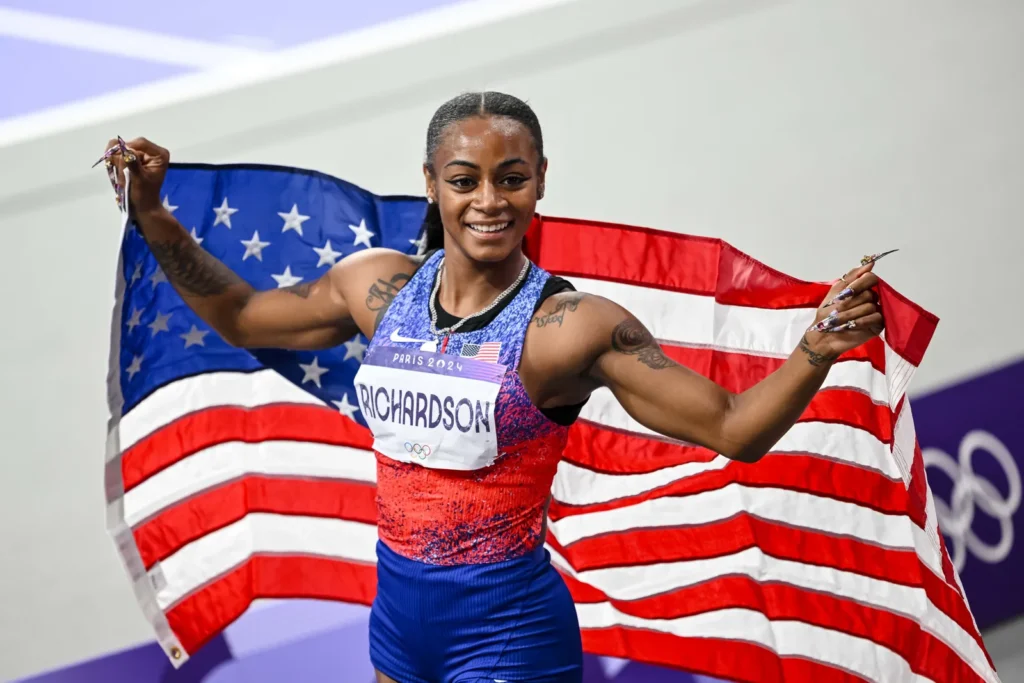
Richardson’s most powerful brand-building tool is her appearance but not in the superficial sense. Her look is a statement. In a sport where athletes are often expected to minimize themselves, she maximized every visible aspect of her identity. The hair, the nails, the competitive aggression all of it communicates a specific message: I will not shrink for you.
That message resonated enormously with a generation of young Black women who had been told, in various ways and contexts, to make themselves smaller. Richardson didn’t just win races. She gave her audience a figure who represented refusal of conformity, of diminishment, of the idea that athletic excellence requires personal suppression.
Commercially, this translates directly. Brands that target Gen Z consumers, Black consumers, and female consumers found in Richardson a figure with authentic credibility that no amount of conventional marketing could manufacture.
Key Lessons & Tactics
The first lesson is that authenticity creates commercial value when it’s genuine. Richardson’s look and attitude aren’t a marketing strategy they’re who she is. The commercial success followed from that, rather than the reverse.
Second, personality is a moat. In a competitive endorsement market, athletes who are interchangeable lose deals to those who are distinctive. There is only one Sha’Carri Richardson. That uniqueness commands premium pricing.
Third, crisis management is character management. Her response to the Tokyo suspension emotional, honest, taking responsibility while contextualizing the circumstances was more effective than any PR strategy. She spoke like a human being and the public responded accordingly.
Fourth, choose partners who align with your cultural identity. The Mielle partnership works precisely because it’s coherent with who she is.
Fifth, build the brand before the championships. Richardson had significant commercial value before winning a World Championship. That positioning meant her wins became commercial accelerants rather than commercial preconditions.
Challenges, Controversies & Failures
The Tokyo suspension was the defining challenge. The facts were genuinely complex she had used marijuana in Oregon, where it was legal, after receiving devastating personal news through an inappropriately delivered media inquiry. The USADA rules did not provide for context. The public reaction was largely sympathetic. The commercial fallout was minimal.
Her subsequent competitive journey included inconsistent performances that frustrated expectations. She had to manage the gap between extraordinary promise and a professional career still establishing itself at the highest level. That gap between potential and actualized dominance is a commercial risk when sponsors are paying for a champion.
Current Empire & Net Worth Perspective
Richardson’s net worth is estimated in the low millions, with trajectory pointing substantially higher. Her commercial portfolio is built for the next decade her major partnerships are structured around longevity, not event-based spikes. As her competitive career reaches full maturity, the commercial architecture already in place will amplify significantly.
Conclusion
Sha’Carri Richardson is running toward something larger than a finish line. She is building a legacy that is as much cultural as athletic the fastest woman in American history who also happened to change what a track athlete could look like, sound like, and be worth commercially.
Her business lesson is simple and profound: be so distinctly yourself that copying you is impossible. In a crowded market for human attention, that is the only truly defensible brand position.



