

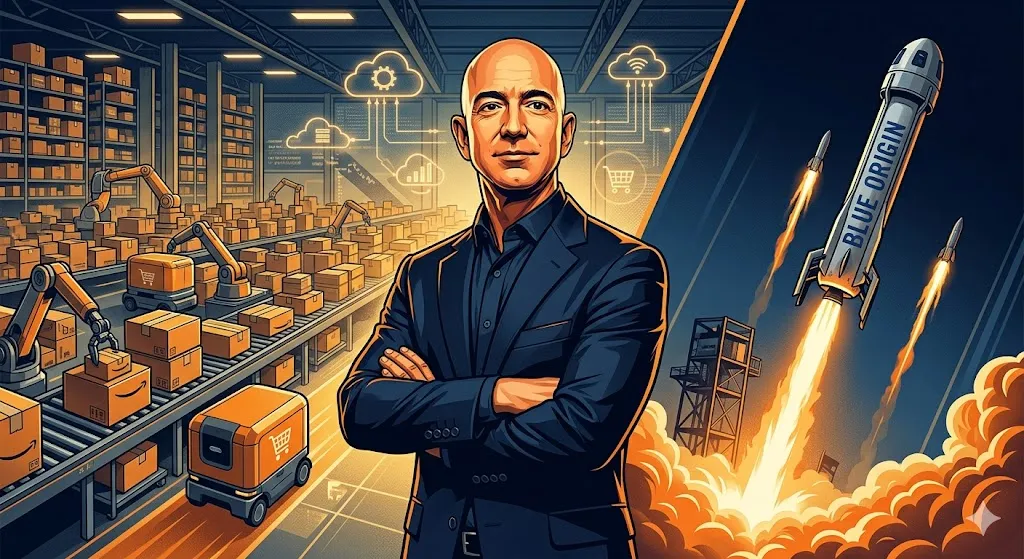
In 1994, Jeff Bezos was a senior vice president at one of Wall Street’s most prestigious hedge funds, earning a comfortable six-figure salary with a clear path to becoming extremely wealthy. He quit to sell books on the internet out of his garage. His boss at the time thought he was making a catastrophic mistake. Thirty years later, Bezos built the company that redefined retail, cloud computing, logistics, and entertainment all at once. The garage is now a museum piece.
Early Life and Career Foundation
Bezos was born in Albuquerque, New Mexico in 1964. His mother was a teenager when she had him, and his biological father was largely absent. His stepfather, Miguel Bezos, a Cuban immigrant who came to America with almost nothing, became his greatest influence. Bezos spent summers on his grandfather’s ranch in Texas, learning self-reliance and problem-solving from an early age. He was mechanically obsessed as a child, once rigging an electric alarm to keep his siblings out of his room.
He excelled academically, graduating summa cum laude from Princeton with degrees in electrical engineering and computer science. He climbed quickly through Wall Street, reaching DE Shaw and Co, a quantitative hedge fund, where he rose to senior vice president by his early thirties. He was good at finance, but he was restless.
The turning point came in 1994 when he read a statistic that internet usage was growing at 2,300 percent annually. He made a list of products that could be sold online and landed on books because of the enormous catalog size and standardized format. He drove cross-country to Seattle while his wife MacKenzie took notes for the business plan in the passenger seat.
Business Evolution
What separated Bezos from other early e-commerce founders was his absolute refusal to optimize for short-term profit. Amazon lost money for years, and Bezos was completely unapologetic about it. He told shareholders in his very first annual letter in 1997 that he would always prioritize long-term value creation over quarterly earnings. He kept that letter pinned to every subsequent shareholder communication for over two decades as a reminder that the strategy had never changed.
The mindset shift that defined Amazon’s business evolution was Bezos’s concept of working backward from the customer. Instead of asking what technology can we build, he asked what does the customer need, and then built the technology to deliver it. That inversion sounds simple but it is extraordinarily rare in practice.
Major Business Ventures
Amazon Prime, launched in 2005, is one of the most strategically brilliant moves in business history. On the surface it was a shipping subscription. In reality it was a loyalty lock-in mechanism that made switching to a competitor psychologically and financially costly. Prime members spend roughly twice as much on Amazon as non-Prime members annually. By 2023, Prime had over 200 million subscribers globally, generating billions in recurring subscription revenue before a single product was sold.
Amazon Web Services was the move that almost no one saw coming. Bezos noticed that Amazon had built sophisticated internal computing infrastructure to run its own operations, and realized other companies needed the same infrastructure but could not afford to build it themselves. AWS launched in 2006 as a cloud computing service and is now the dominant player in a market worth hundreds of billions annually. AWS consistently generates over 60 percent of Amazon’s total operating profit despite representing a fraction of its total revenue. Without AWS, Amazon’s retail operation would be a much thinner business.
The acquisition of Whole Foods in 2017 for 13.7 billion dollars was a clear signal that Bezos was not content owning the digital shelf. He wanted the physical one too. The move gave Amazon a premium grocery footprint, a last-mile distribution network, and a wealthy, loyal customer base that overlapped precisely with Prime membership demographics.
Strategic Thinking and Brand Building
Bezos built Amazon’s brand not through advertising but through consistency of experience. The promise was always the same: low prices, vast selection, and fast delivery. Every operational decision was made to protect that promise. He famously placed an empty chair in meetings to represent the customer, reminding his teams that the customer was always the most important person in the room.
His monetization strategy evolved from thin retail margins to a layered ecosystem. Amazon collects revenue from product sales, third-party seller fees, Prime subscriptions, AWS contracts, advertising, and original content through Prime Video. Each layer feeds the others. Sellers pay fees to reach Prime customers. Advertisers pay to reach those same customers. AWS profits fund the retail expansion. It is one of the most interlocking business models ever constructed.
Key Lessons and Tactics
First, think in decades, not quarters. Bezos explicitly told investors not to expect short-term profits, and the ones who stayed were rewarded beyond imagination. Second, infrastructure is a product. AWS turned Amazon’s internal cost center into its most profitable division. Third, obsess over the customer, not the competitor. Amazon rarely talks about what rivals are doing. It talks about what customers need next. Fourth, build flywheels, not funnels. Every Amazon product feeds traffic and profit back into the ecosystem. Fifth, embrace failure as a budget line. Bezos has said Amazon has made billions of dollars of failures, including the Fire Phone, and considers it the price of innovation. Sixth, vertical integration compounds over time. Amazon builds its own warehouses, delivery fleet, payment systems, and chips. Seventh, make switching painful in a good way. Prime is designed to make leaving Amazon feel like a loss.
Challenges, Controversies, and Failures
Amazon has faced sustained criticism on multiple fronts. Its treatment of warehouse workers, including grueling productivity targets, high injury rates, and aggressive opposition to unionization efforts, has drawn significant regulatory and media scrutiny. The Fire Phone, launched in 2014, was an embarrassing product failure that cost Amazon over 170 million dollars in write-offs. Bezos’s personal life also became a public controversy when his divorce from MacKenzie Scott in 2019, following a tabloid exposure of an extramarital affair, became one of the most scrutinized in history.
Antitrust regulators in the United States and Europe have increasingly targeted Amazon’s market power, particularly around whether it uses third-party seller data to unfairly advantage its own private label products.
Current Empire and Net Worth Perspective
Bezos stepped down as Amazon CEO in 2021, handing the role to Andy Jassy, though he remains executive chairman. His current net worth sits around 200 billion dollars. Outside of Amazon, he owns Blue Origin, his space exploration company working toward commercial space travel and lunar infrastructure, the Washington Post, a fleet of superyachts, and Bezos Expeditions, his personal investment vehicle with stakes across technology, healthcare, and media.
Conclusion
Jeff Bezos did not build a bookstore. He built the infrastructure of modern commerce, one deliberately unprofitable quarter at a time, until the flywheel was spinning too fast for anyone to stop. His career is a masterclass in patience as a competitive weapon. In a business world obsessed with this quarter’s numbers, Bezos proved that thinking further ahead than everyone else in the room is the most durable advantage of all.
The man who drove to Seattle with a business plan written on a notepad has reshaped how the world shops, stores data, and watches television. That is not disruption. That is construction.



