

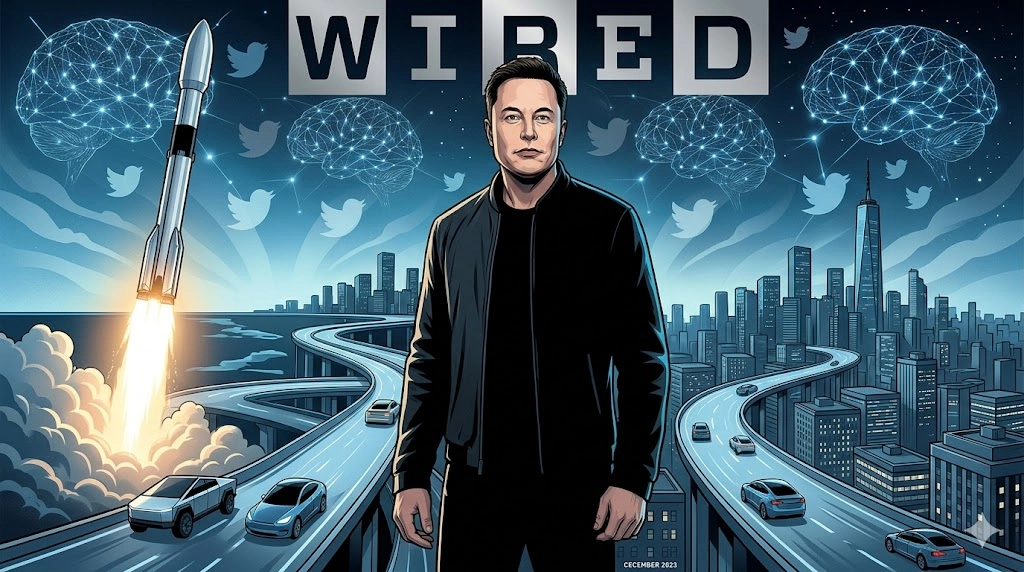
In 2002, Elon Musk sold his share of PayPal for $165 million. Most people would have retired. Instead, he walked into the offices of aerospace engineers and asked how much it would cost to buy a rocket. When they laughed at him, he went home and taught himself rocket science from textbooks. That single moment captures everything you need to understand about how Elon Musk thinks about business.
Early Life and Career Foundation
Musk was born in Pretoria, South Africa in 1971. A self-taught coder by age 12, he sold his first software, a video game called Blastar, for $500. He moved to Canada at 17, then transferred to the University of Pennsylvania, where he studied economics and physics. He briefly enrolled in a Stanford PhD program in energy physics but dropped out after two days to chase the internet boom. That impatience would define his entire career.
His first company, Zip2, was a digital city guide he built with his brother Kimbal. They slept in the office and shared a single computer. Compaq acquired Zip2 in 1999 for $307 million. Musk pocketed $22 million at age 27. His follow-up, X.com, an online payments company, eventually merged with Confinity to become PayPal, which eBay bought for $1.5 billion in 2002.
The turning point was not the money. It was the decision about what to do with it.
Business Evolution
Where most entrepreneurs cash out and diversify safely, Musk concentrated risk. He put $100 million into SpaceX, $70 million into Tesla, and $10 million into SolarCity, nearly going bankrupt in the process. In 2008, Tesla was days away from collapse and SpaceX had just watched its third consecutive rocket fail. Musk transferred money between the companies to keep both alive. That willingness to sit inside the fire rather than run from it is his defining business trait.
The mindset shift that separates Musk from other wealthy founders is this: he does not build companies to make money. He builds them to solve what he calls “civilizational-scale problems.” That framing changes every business decision. Margins, quarterly earnings, and exit strategies become secondary to mission execution.

Major Business Ventures
Tesla is the clearest proof of his strategy. Musk did not invent the electric car, but he understood that perception was the biggest barrier to adoption. He built the Roadster, a sports car, not to generate profit, but to shatter the image of EVs as slow and boring. Every subsequent model followed a premium-to-mass-market waterfall strategy. By 2023, Tesla had delivered over 4.7 million vehicles globally and held a market cap that at its peak exceeded that of Toyota, Volkswagen, and Ford combined.
SpaceX rewrote the economics of space. By developing reusable rockets, the company dropped launch costs from roughly $60,000 per kilogram to under $2,000. The US government, which once paid Russia to transport astronauts to the ISS, now contracts SpaceX for billions. The Starlink satellite internet division alone is projected to generate tens of billions annually.
His 2022 acquisition of Twitter for $44 billion, rebranded as X, was controversial but strategic in a specific sense. Musk envisions X as an “everything app,” modeled on China’s WeChat, combining social media, payments, and commerce in one platform. Whether it succeeds or not, the logic is consistent with his larger pattern: acquire an underperforming asset, strip the cost structure, and rebuild around a bigger thesis.
Strategic Thinking and Brand Building
Musk’s personal brand is inseparable from his companies. Unlike traditional CEOs who stay behind polished press releases, Musk uses social media as a direct channel to customers, investors, and critics. A single tweet has moved cryptocurrency markets, influenced Tesla’s stock price, and generated global news cycles. This is not recklessness. It is leverage. He is his own media company.
His monetization approach centers on ownership, not salary. For years, Musk took no cash salary from Tesla. His compensation was tied entirely to performance milestones, specifically stock options that would only vest if Tesla hit ambitious targets around revenue, market cap, and vehicle delivery. When Tesla hit those targets, the compensation package became the largest in corporate history.
Key Lessons and Tactics
First, think at civilizational scale. Problems that sound impossibly large attract exceptional talent and unlimited capital. Second, vertical integration is a competitive moat. Tesla builds its own batteries, chips, software, and charging infrastructure. Control the supply chain and you control the margin. Third, use your personal brand as a distribution channel. Musk’s social media presence reduces Tesla’s marketing spend to near zero. Fourth, concentrate risk when conviction is high. Diversification is for people who do not know what they are doing. Fifth, set targets that seem unreasonable. SpaceX engineers initially said reusable rockets were impossible. The impossible deadline forced innovation. Sixth, turn customers into believers. Tesla owners do not just buy cars, they buy into a movement. Seventh, enter regulated industries others fear. Energy, automotive, and aerospace are hard to enter precisely because the barriers keep competitors out.

Challenges, Controversies, and Failures
The failures are real and well documented. The first three SpaceX rocket launches exploded. Tesla nearly went bankrupt twice. The Solar City acquisition was criticized as a bailout of a struggling company where Musk had family ties. His management style is intense to the point of brutality, with reported mass layoffs, unrealistic deadlines, and public humiliation of employees. The Twitter acquisition wiped out billions in advertiser revenue and exposed significant operational chaos. Courts have also challenged his compensation packages, and regulators have repeatedly scrutinized his disclosures.
What Musk does with failure is instructive. He treats it as data. After each failed SpaceX launch, the team did a public post-mortem. After Tesla’s near collapse in 2008, he restructured the board and doubled down on product quality. He does not retreat from failure. He iterates faster.
Current Empire and Net Worth Perspective
As of 2025, Musk’s net worth fluctuates around $200 billion, making him consistently one of the two or three wealthiest people on earth. His business ecosystem spans electric vehicles, space transportation, satellite internet, artificial intelligence through xAI, tunneling through the Boring Company, and social media through X. His influence on government policy, through the Department of Government Efficiency advisory role in the US, has added a political dimension to his portfolio that few entrepreneurs have ever occupied.
Conclusion
Elon Musk is not a tech entrepreneur. He is a systems thinker who uses technology as his tool. His real skill is seeing the future as a near-certain destination and building backward from it. The lesson his career offers is not that you need his genius or his risk tolerance. It is that the size of your ambition determines the quality of your strategy. Small goals produce safe, forgettable businesses. Musk’s goals have always been large enough to make the impossible feel like the only logical option.
The man who once could not afford to buy a used rocket now runs the company that launches them. That gap between where he started and where he stands is not luck. It is a repeatable philosophy.


