

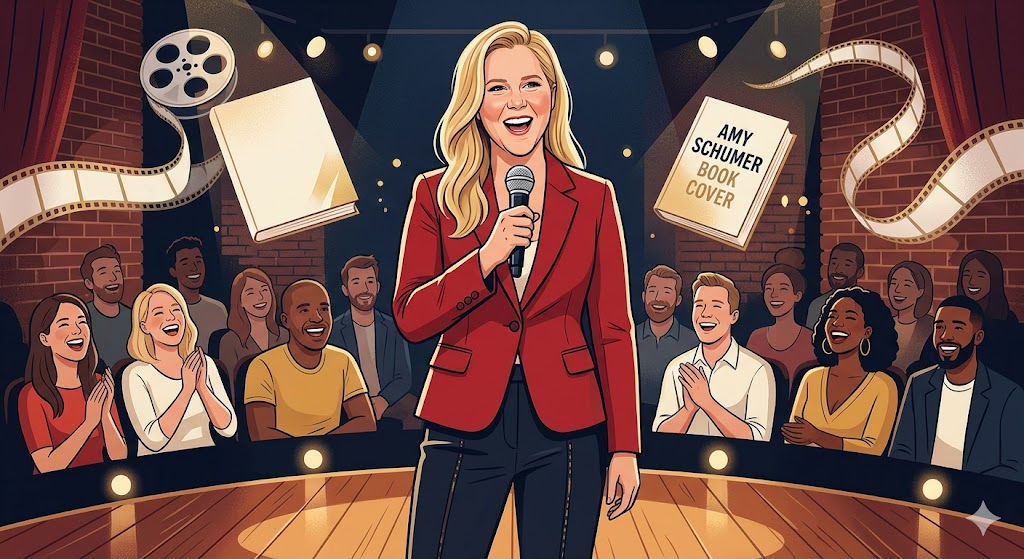
Amy Schumer did not become famous by playing it safe. She became famous by saying the things that women had been thinking for years but had been told, implicitly and explicitly, not to say out loud. And then she turned that permission structure into a multimillion-dollar media business that spans television, film, streaming, books, and live performance.
Early Life and Career Foundation
Amy Beth Schumer was born on June 1, 1981, in New York City and raised on the Upper East Side before her family’s financial situation changed significantly following her father’s business failure. Her father was diagnosed with multiple sclerosis, the family lost their money, and Schumer grew up navigating the gap between her early privileged environment and the financial reality that followed. That contrast became material, and more importantly, it became empathy.
She studied theater at Towson University and began performing stand-up in New York in the early 2000s, working the same club circuit that had launched dozens of comedians before her. She was raw, unfiltered, and willing to be the subject of her own jokes in ways that felt genuinely risky rather than performatively self-deprecating.
Business Evolution
The real turning point was Inside Amy Schumer, the sketch comedy series she created and starred in for Comedy Central beginning in 2013. The show won a Peabody Award and an Emmy and demonstrated that Schumer was not just a performer but a writer, producer, and creative director with a specific and sophisticated point of view. She was not handed a platform. She built one.
The show created the foundation for everything that followed. It gave her the credibility to command a major film deal, a book deal, and eventually a Netflix relationship, all of which came in rapid succession between 2015 and 2017.

Major Business Ventures
Trainwreck, the 2015 Universal Pictures film she wrote and starred in, grossed over $140 million worldwide against a production budget of approximately $35 million. It was a genuine commercial and critical success and proved that Schumer could open a film, a metric that Hollywood uses to determine who gets the biggest deals. That proof of concept translated directly into her negotiating power for subsequent projects.
Her book, The Girl with the Lower Back Tattoo, published in 2016, debuted at number one on the New York Times bestseller list. It was not a celebrity vanity project. It was a genuinely personal memoir that resonated with readers across demographics and demonstrated that her audience would follow her across formats.
Her Netflix special, The Leather Special in 2017, received mixed reviews but confirmed her place in the premium stand-up market. She has continued to release content through streaming platforms, and her live touring has been a consistent income driver throughout her career.
She also launched Amy Schumer Presents, a production banner through which she has developed projects for other comedians and writers, extending her role from talent to creative entrepreneur..
Strategic Thinking and Brand Building
Schumer’s brand is built on radical honesty, particularly around body image, relationships, and the experience of being a woman navigating industries that were not designed with women in mind. That brand is both personally authentic and commercially strategic. It resonates deeply with a specific audience, women aged roughly 25 to 50, that advertisers and platforms have consistently underserved and therefore aggressively compete to reach.
Her willingness to discuss her health openly, including her diagnosis of Lyme disease and her experience with endometriosis, has deepened her connection with audiences in ways that purely comedic content cannot. Vulnerability, when it is genuine, is one of the most powerful brand-building tools available, and Schumer has deployed it with a consistency that feels less like strategy and more like character.

Key Lessons and Tactics
The first lesson from Schumer’s career is that creating your own platform, rather than waiting to be invited onto someone else’s, is the fastest path to creative and financial control. The second is that cross-format expansion multiplies your audience. Each new format, television, film, books, live performance, reaches segments of the market that the others do not.
The third lesson is that authenticity targeted at an underserved audience builds loyalty faster than broad appeal aimed at everyone. The fourth is that producing other people’s work is a scalable business model in a way that performing your own work is not. The fifth lesson is that health struggles, when handled publicly and honestly, can deepen brand connection rather than damage it. The sixth is that a number one bestselling book is not just a revenue event. It is a proof point that travels across industries and opens rooms that stand-up credentials alone would not. The seventh is that critical reception and commercial performance are different metrics, and confusing them is a costly mistake.
Challenges, Controversies, and Failures
Schumer has faced accusations of joke theft from other comedians, a serious charge in the stand-up world where material is the primary asset. She has also faced criticism for cultural insensitivity in some of her earlier material. These controversies generated significant media coverage and damaged her reputation in certain circles, particularly within the comedy community.
Her Netflix special received notably poor audience ratings, which was a public stumble for a performer at the height of her commercial power. Some of her later film projects have underperformed relative to the expectations set by Trainwreck.
Current Empire and Net Worth Perspective
Amy Schumer’s net worth is estimated at approximately $25 million, with income generated through touring, streaming deals, film residuals, book royalties, and her production company. She remains one of the most commercially active female comedians in the industry and continues to develop projects across multiple formats.
Her broader impact on the industry is difficult to quantify but impossible to ignore. She helped shift the conversation around what female comedians were allowed to talk about and proved that unapologetically female-centered content could generate mainstream commercial success at scale.
Conclusion
Amy Schumer built her business the hard way, by creating content that made people uncomfortable enough to pay attention and relatable enough to keep coming back. She turned personal experience into intellectual property, and intellectual property into a multimedia business that has outlasted the cultural moment that created it.
The takeaway is this. The audience that feels most seen by you will be your most loyal customers. Find them, speak directly to them, and build everything else from there.



