


Before he was Common, he was Lonnie Rashid Lynn Jr., sitting in a Florida A&M classroom studying business administration while dreaming about a music career. That detail gets buried in most profiles. It should be the headline. The man who would eventually become the first rapper to win a Grammy, an Oscar, and an Emmy built his empire the way most great businesses are built: with a long-term framework developed years before the revenue arrived.
As of 2025, Common’s net worth is estimated at $45 million, a figure that continues to grow thanks to new acting projects, production roles, and entrepreneurial ventures. But the number is almost secondary to the method.
THE FOUNDATION: CHICAGO TO THE UNDERGROUND
Common was born Lonnie Rashid Lynn Jr. in Chicago, Illinois. His mother was a teacher, and his father was an ABA basketball player who later became a youth counsellor. Common attended Florida A&M University, where he studied business administration. He left before graduating, but the business framework stayed. Every subsequent deal he structured reflected that early exposure to how organisations think about value, risk, and long-term return.
With the 1994 release of Resurrection, Common achieved significant critical acclaim extending beyond the Chicago music scene. The groundbreaking single “I Used to Love H.E.R.” earned him serious recognition in hip-hop circles. But underground credibility does not pay bills. For most of the nineties, Common was critically lauded and commercially limited, a position that forced creative thinking about how to convert cultural capital into actual capital.
THE PIVOT: KANYE, HOLLYWOOD, AND THE OSCAR
The shift began with Kanye West. His 2005 album Be, produced primarily by West, repositioned Common from a niche underground artist to a mainstream cultural figure. That repositioning was the prerequisite for everything that followed.
Common’s Hollywood move was not accidental, and it was not easy. He took acting classes between tours and faced countless rejections before landing breakthrough roles. “I had to fight for people to see me as an actor,” he admitted, noting the projects he wanted were not ones that cast musicians as novelty acts.
His breakthrough in Hollywood came with Smokin’ Aces in 2006, but his portrayal of civil rights leader James Bevel in Selma in 2014 garnered widespread acclaim. The film earned him an Academy Award for Best Original Song for “Glory,” co-written with John Legend.
Research shows an Academy Award can boost an actor’s earning potential dramatically. Oscar winners command significantly higher salaries in future projects. Common understood this immediately and moved to convert his elevated status into institutional infrastructure.
THE EMPIRE: PRODUCTION, MANAGEMENT, AND REAL ESTATE
In October 2015, Common signed a two-year deal with HBO that allowed him to start Freedom Road Productions, his own film production company. Moving from talent to producer means you stop earning a flat fee and start earning on the back end. You own stakes in content rather than renting your face to it. Freedom Road Productions signed an overall television deal with Lionsgate in 2018, producing successful content, including the Showtime drama series The Chi. Rock & Roll Hall of Fame, HotNewHipHopp
Common also co-founded SMAC Entertainment, a talent management and media company, with business partner Derek Dudley. SMAC focuses on developing and managing talent across music, sports, and entertainment. The company’s client roster includes rapper Wiz Khalifa, television personality Michael Strahan, and Deion “Coach Prime” Sanders, with recent productions including the documentary BS High on MAX and the second season of Coach Prime for Prime Video. A talent management company earns revenue from dozens of clients simultaneously. That is leverage no solo career can replicate.
His most ambitious real estate venture is involvement in a $1.6 billion initiative to revitalise Chicago’s South Side, partnering with other Black investors to develop residential, commercial, and community spaces in long-underserved neighbourhoods. This investment generates returns, deepens his brand’s Chicago identity, and creates the kind of community goodwill that no marketing budget can manufacture.
THE BRAND: WHERE PURPOSE AND PROFIT CONVERGE
Common’s Common Ground Foundation, founded in 2002, grows alongside his personal wealth, targeting youth in underserved communities with education, career development, and arts programming. His genuine dedication to social causes improves his appeal among conscious consumers.
Common also co-founded Art In Motion, a tuition-free creative arts school established in 2011. These are not celebrity charity checkboxes. They are extensions of a personal brand built on the premise that intelligence, creativity, and social consciousness are inseparable. That brand attracts institutions, studios, and corporations wanting to align with those values, which means better deal flow and better deal terms.
LESSONS FROM COMMON’S PLAYBOOK
The first lesson is to study business even when studying art. His Florida A&M business administration background gave him a framework most artists never develop.
The second is that underground credibility is a long-term asset. Common spent a decade building it before the mainstream caught up. When it did, that credibility was worth more than any number of radio hits.
The third is to convert awards into industry access. His Oscar immediately became a negotiating instrument for production deals and higher-value acting contracts.
The fourth is that management companies are underrated wealth vehicles. SMAC Entertainment earns revenue from dozens of clients simultaneously with less personal risk than any solo venture.
The fifth is to invest where your brand already lives. His South Side Chicago real estate project aligns with everything his audience already believes about him.
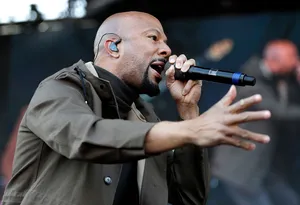
CHALLENGES AND THE COST OF INTEGRITY
Early in his career, money was tight. He later revealed they could not afford to develop tracks at recording studios and had to prepare everything at home to maximise limited studio time. That resourcefulness shaped every subsequent business decision. His commitment to only taking projects that align with his values has also meant turning down lucrative but misaligned opportunities throughout his career. That discipline has a real cost in foregone revenue. But it ensures that when he does attach his name to something, it carries weight a diluted brand cannot match.
THE CURRENT EMPIRE
With an estimated net worth of $45 million in 2025, Common’s wealth reflects diversified income from music royalties, acting, real estate, wellness investments, and his talent management company. His acting work continues expanding with a role in Apple TV’s Silo and a Broadway debut in Between Riverside and Crazy. Freedom Road Productions continues developing content. SMAC Entertainment grows its client base. And his South Side Chicago project represents potentially the largest single asset in his portfolio if it reaches full scale.
THE TAKEAWAY
Common built his empire on a philosophy most entertainers treat as a luxury: that authentic values and financial ambition are not in conflict. He inverted the usual model. Purpose is the foundation, and commerce is what gets built on top. That inversion turned out to be worth $45 million and counting. In an industry where most careers peak in five years, Common is still landing prestige roles, signing major deals, and shaping conversations three decades after his first album. That is not luck. That is architecture.



