


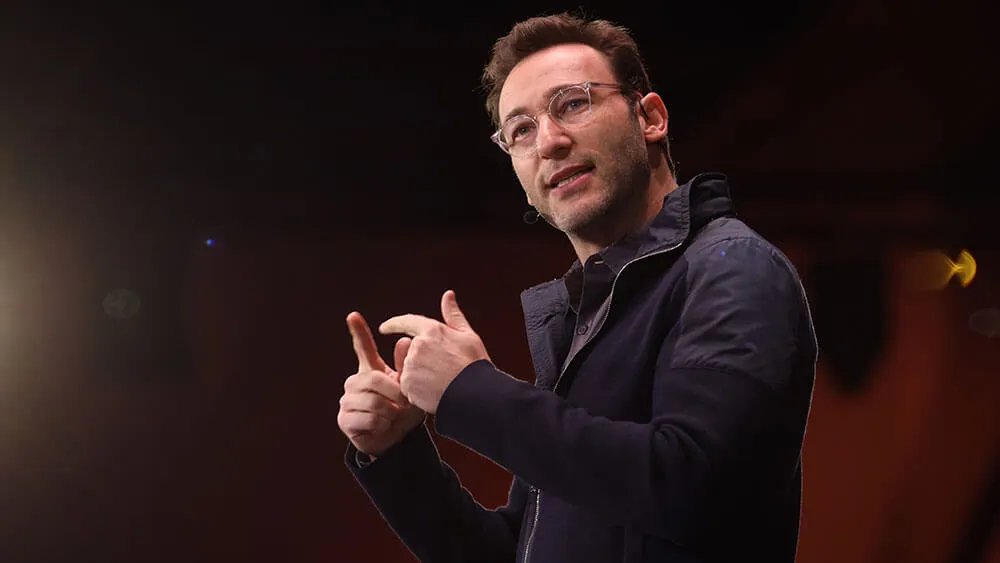
In 2009, Simon Sinek stood on a small TED stage and drew a circle on a whiteboard. Inside the circle he wrote the word “Why.” Outside it, he wrote “How” and “What.” He called it the Golden Circle, and he argued that the world’s greatest leaders and companies communicate from the inside out, starting with purpose rather than product. It was a simple idea. It was also, whether by design or , one of the most profitable frameworks a business author has ever produced.
That TED Talk has now been watched over 60 million times, making it one of the most viewed in history. But the more interesting story is not the talk itself. It is what Sinek built in the decade and a half that followed, and how a single visual metaphor became the engine of a multimillion-dollar consulting and publishing enterprise.
Early Life and Career Foundation
Sinek was born in Wimbledon, England, and raised partly in Hong Kong and the United States. He studied law at City University London before transferring to Brandeis University to study cultural anthropology, a pivot that reflects the kind of intellectual restlessness that tends to precede disruptive thinking.
After college, he entered the advertising world, joining Euro RSCG and later Ogilvy and Mather. Advertising gave him two things that would prove essential: an understanding of how brands communicate at scale, and a front-row seat to how most of them do it poorly. By his late twenties, he had launched his own small marketing consultancy, but it was struggling. He has described a period of genuine professional depression, feeling directionless and ineffective.
It was during that low point, he says, that he reverse-engineered his own sense of purpose and arrived at the Why framework. He didn’t invent it to sell. He built it to save himself, and then noticed it worked for organizations too.
Business Evolution
The 2009 TED Talk was the inflection point, but Sinek had already published Start With Why that same year, through Portfolio, a Penguin imprint. The timing was deliberately aligned. The book and the talk were essentially a two-part product launch, each amplifying the other. This was not accidental. Sinek understood, even at that early stage, that ideas scale through systems, not through individual performances.
The critical mindset shift was recognizing that the Golden Circle was not just a book premise. It was intellectual property that could underpin workshops, keynote speeches, training programs, leadership curricula, and eventually an entire organizational consulting practice. Most authors write books. Sinek wrote a platform.
Major Business Ventures
Sinek’s primary business vehicle is SinekPartners, his consultancy, which works with corporations, nonprofits, and government organizations on leadership and culture. Clients have included Microsoft, American Airlines, the United Nations, and various branches of the US military. The military work is particularly significant because it gave Sinek credibility that the corporate circuit alone cannot provide. Being trusted by institutions that deal in life-and-death leadership adds a weight to his brand that no publishing deal can manufacture.
His book catalog has expanded strategically. Leaders Eat Last in 2014, The Infinite Game in 2019, and several shorter publications have each extended the franchise without fragmenting it. Each book takes a different angle on the same core territory: how do organizations build cultures where people feel safe, purposeful, and committed? The coherence is intentional. He is not chasing new topics. He is deepening the same territory.
The speaking business is enormous. Sinek commands fees reportedly in the $100,000 to $200,000 range per engagement, and his calendar is reliably full. More importantly, every speaking engagement is also a marketing event for the books, the consulting, and the online programs, creating a flywheel that amplifies itself.
Strategic Thinking and Brand Building
Sinek’s genius, from a brand-building perspective, is his visual simplicity. The Golden Circle is a circle with three rings. A child can draw it. An executive can remember it. That memorability is not accidental. In a world drowning in complexity, a framework simple enough to sketch on a napkin travels faster and farther than any sophisticated model.
He has also been careful to stay accessible without becoming mainstream. He posts consistently on LinkedIn and other platforms, but his content is disciplined: always on-message, always circling back to purpose, trust, and leadership. He doesn’t comment on politics, celebrity, or trending topics. He stays in his lane with the consistency of someone who has understood for a long time that authority is built through repetition, not novelty.
Key Business Lessons from Simon Sinek
The first lesson is that a single powerful framework, well communicated, is worth more than a dozen half-developed ideas. The second is that TED is a business development tool, not just a prestige platform. A great talk is top-of-funnel marketing for everything downstream. The third is that visual simplicity creates viral ideas. The circle travels further than the treatise.
The fourth lesson is that coherence builds authority. Stay in your lane long enough and you own it. The fifth is that military and institutional credibility adds commercial value. The sixth is that books, talks, and consulting should form a reinforcing system, not separate businesses. The seventh is that purpose-led messaging is commercially effective precisely because it is rare.
Challenges and Failures
Sinek has faced criticism from organizational theorists and business academics who argue that the Why framework oversimplifies the mechanics of organizational leadership. Some researchers have pointed out that the empirical evidence for the model as a predictive business tool is thin. This is a real vulnerability for a brand built on the language of science and research.
His response has been to lean into narrative and human testimony rather than data, which has worked commercially but occasionally left him exposed to the charge of being inspirational rather than instructive. It is a tension that any thought leader who deals in frameworks rather than findings must manage.
He has also been relatively slow to build a digital product empire compared to peers. His online course presence is modest, and some analysts have noted that his revenue is heavily weighted toward high-touch, time-intensive engagement. This is not a failure exactly, but it may be a ceiling.
Current Empire and Net Worth
Sinek’s estimated net worth is between $15 million and $20 million. His primary revenue streams are speaking fees, book royalties, consulting through SinekPartners, online content, and corporate training programs. His books have sold in the tens of millions of copies across multiple translations and formats.
His cultural influence extends well beyond his financial footprint. The Why framework is now embedded in business school curricula, military leadership training, and corporate onboarding programs on every continent. That embedded adoption functions as a permanent distribution network for every future product he releases.
Conclusion
Simon Sinek built a business empire from a whiteboard drawing, and that is not a criticism. It is perhaps the purest expression of what the knowledge economy rewards: the ability to take something complex, reduce it to its essential truth, and communicate that truth in a way that makes people feel both seen and capable.
The takeaway is not to find your Why in some abstract motivational sense. It is to understand that ideas, packaged correctly and distributed at scale, are assets. Sinek owns his ideas completely, licenses them globally, and built an institution around them. That is a business model as durable as any factory and far cheaper to operate.



